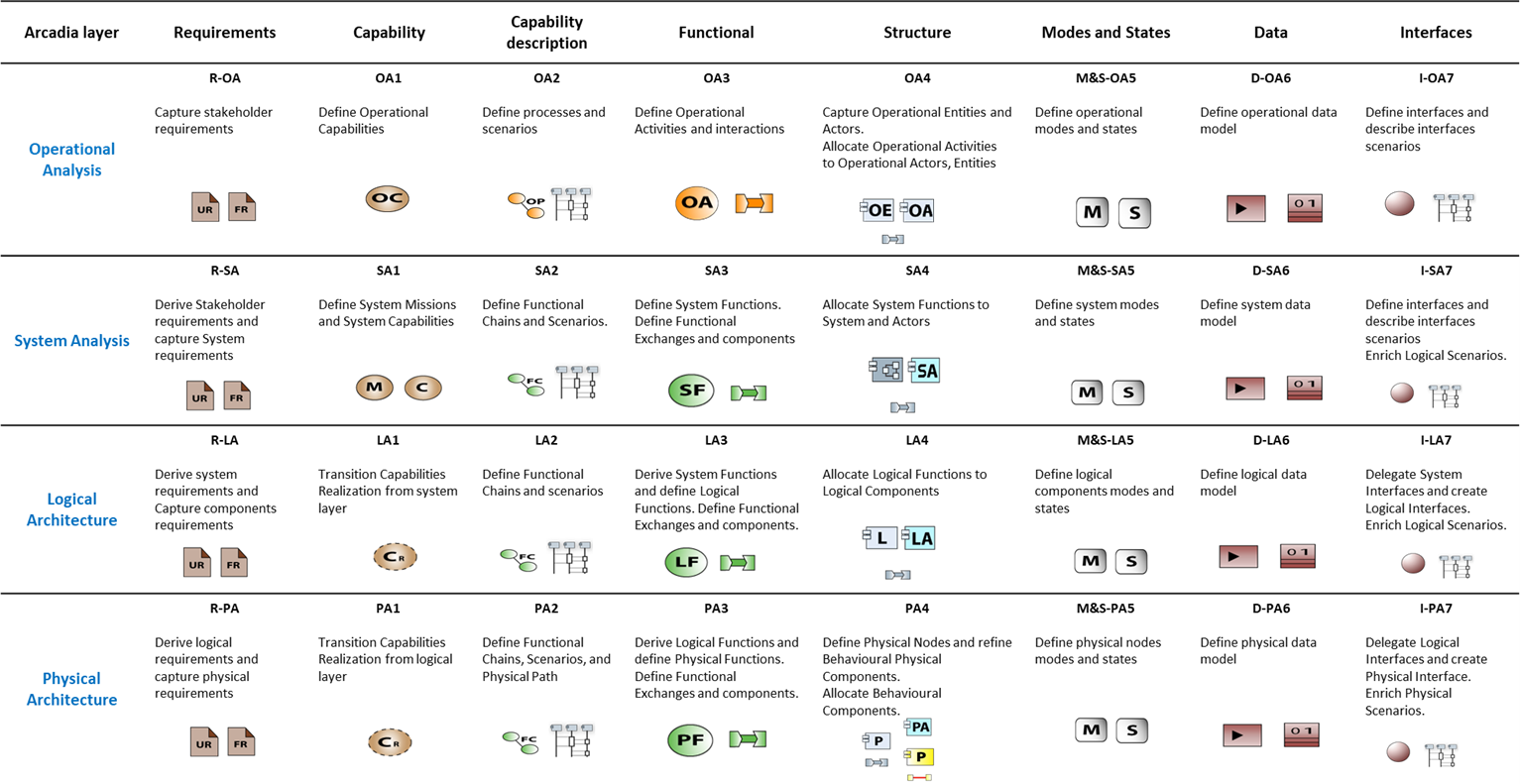
Arcadia is a tooled method devoted to systems & architecture engineering, supported by Capella modelling tool.
It describes the detailed reasoning to
It can be applied to complex systems, equipment, software or hardware architecture definition, especially those dealing with strong constraints to be reconciled (cost, performance, safety, security, reuse, consumption, weight…).
It is intended to be used by most stakeholders in system/product/software or hardware definition and IVVQ as their common engineering reference and collaboration support.
Arcadia stands for ARChitecture Analysis and Design Integrated Approach.
A series of online documents to dive into the principles and concepts of Arcadia:
Arcadia is a system engineering method based on the use of models, with a focus on the collaborative definition, evaluation and exploitation of its architecture.
This book describes the fundamentals of the method and its contribution to engineering issues such as requirements management, product line, system supervision, and integration, verification and validation (IVV). It provides a reference for the modeling language defined by Arcadia.
Jean-Luc Voirin, leader of the creation of the Arcadia method, along with some of the leaders on developing and deploying MBSE Arcadia & Capella practices in Thales. From right to left: Pierre Nowodzienski, Jean-Luc Voirin, Juan Navas, Stephane Bonnet, Frederic Maraux, Gerald Garcia, Philippe Fournies, Eric Lepicier.
Architecture as prime engineering driver
Arcadia, a model-based engineering method
Noticeable features of Arcadia
Definition of the Problem - Customer Operational Need Analysis
Formalization of system requirements - System Need Analysis
Development of System Architectural Design - Logical Architecture (Notional Solution)
Development of System Architecture - Physical Architecture
Formalize Components Requirements - Contracts for Development and IVVQ
Co-Engineering, Sub-Contracting and Multi-Level Engineering
Adaptation of Arcadia to Dedicated Domains, Contexts, Etc.
Equivalences and Differences between SysML and Arcadia/Capella
When other actresses performed this script, the distraction was temporary. With Bing, the script had to be rewritten because the male co-starts kept breaking character—they were actually distracted. Bing is better here because she weaponizes her physiology not as a passive object, but as an active plot device. She doesn’t just stand there; she deploys her leverage.
Today, keywords like "the big distraction carmella bing better" serve as digital artifacts. For SEO professionals and digital archivists, analyzing these long-tail keywords provides valuable insights into user behavior: the big distraction carmella bing better
Based on common methodologies for overcoming distractions, Carmella likely implemented the following: When other actresses performed this script, the distraction
From the outset, Bing carved out a niche for herself in the "big breast" genre of adult films. Her natural, large bust was a key part of her early persona, and she was frequently celebrated for her impressive physique. Her body measurements were often listed as 34DD-26-34, standing at an impressive 5 feet 10 inches, which gave her an exceptionally statuesque appearance. This physical presence, combined with what many described as a remarkable ability to captivate the camera, set her apart from her peers. She doesn’t just stand there; she deploys her leverage